
A Note for Parents
Have you ever experienced such a moment? For a small matter, you patiently explained things many times; the child nodded in agreement at the moment, but after turning around, nothing truly changed. Gradually, your tone becomes urgent, and the child responds with even more resistance. That sense of frustration is very real.
MindFrame invites you to shift your perspective: this might not be your child’s defiance, but rather a failure of the “Behavioral Navigation System” between you. This story about a New York police officer will provide you with a brand-new set of glasses: when we temporarily set aside “who is right and who is wrong” and instead observe the “secret information” in the environment, parenting shifts from exhausting arguments to an effortless “spatial design.”
What Child Will Learn?
This is more than just a story; it’s about helping your child install three mental tools:
- Understanding “Environmental Hints”: Realizing that a messy environment makes people want to cause trouble, while a tidy environment makes people want to follow rules.
- Learning “Result-Oriented” Thinking: Understanding that speaking pretty words is useless; the real strength lies in actually solving problems (fixing the window).
- Actively Maintaining “State of Mind”: Discovering that tidying up a small space around them can actually make their own mood follow suit and improve.
Story Summary
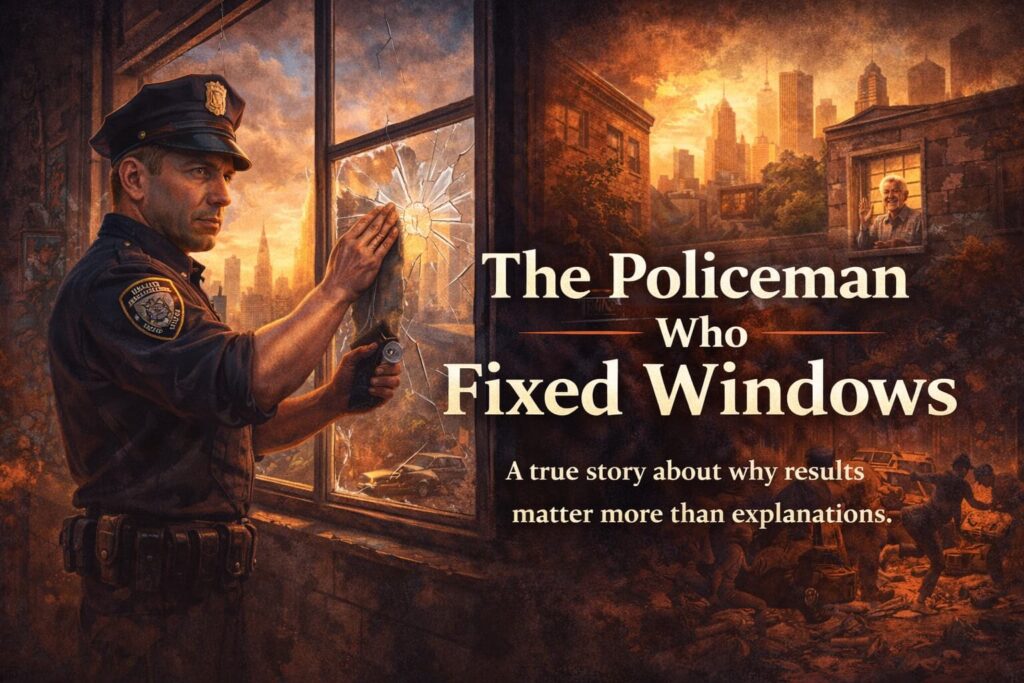
Fifty years ago, New York City was filled with broken glass, layers of graffiti, and fear. Despite government aid and increased patrols, the crime rate remained high. An officer named William proposed a seemingly absurd idea: “Before we catch criminals, we should fix the broken windows.” His colleagues mocked him, suggesting the city needed carpenters, not cops.
William believed that if a place looks neglected, people believe no one is watching. One cold afternoon, he fixed a broken window in a run-down apartment. Later, during a string of local robberies, William noticed a fascinating pattern: every victimized home had broken windows or trash—except for the apartment he had repaired.
He realized a broken window is like an “invitation,” signaling that order is absent. William shifted his strategy to cleaning graffiti and fixing doors. Within six months, crime plummeted. This is the famous “Broken Windows Theory”: the environment silently shapes behavior. William proved that being effective is more important than being right.
System Upgrade
Why don’t slogans and punishments bring lasting order? Because a child’s brain prioritizes environmental signals over your voice. If your home environment hints “it’s okay to be chaotic,” no amount of lecturing will work. Research shows that children who grow up in tidy, well‑structured spaces develop stronger self‑regulation and resilience.
👉 Subscribe now to unlock premium resources:
- Full Storyteller’s Script: A “ready-to-use” script to read a captivating bedtime story without needing any acting skills.
- Psychological Insights: A complete deep dive into how reconstructive defiance interacts with behavioral cues, and how parents can design environments that silently guide behavior.
- Parent-Child Dialogue Toolkit: Scripts to move a child from passive tidying to active environmental maintenance.
Unlock the full [MindFrame] package
Includes: full story script, psychological analysis, and parent–child guidance scripts. Unlock full contentSchalte das vollständige [MindFrame]-Paket frei
Dieser Beitrag enthält: vollständiges Drehbuch, tiefgehende psychologische Analyse und Eltern‑Kind‑Leitfäden. Vollständigen Inhalt freischaltenDébloquez le pack complet [MindFrame]
Cet article comprend : scénario complet, analyse psychologique approfondie et scripts de guidance parent‑enfant. Débloquer l’intégralité du contenuSblocca il pacchetto completo [MindFrame]
Questo articolo include: copione completo della storia, analisi psicologica approfondita e script di guida genitore‑figlio. Sblocca il contenuto completo[MindFrame] 完全アップグレードパッケージを解放
本文には、物語の完全な脚本、心理学的な深掘り解説、親子向けガイド用スクリプトが含まれています。 全文を解放するAge & When to Use
- Recommended Age: 5–12 years old.
- Usage: Repeat 3–5 times for reinforcement.
- Best Scenarios:
- Communication Deadlock: When lecturing has become completely ineffective and the child shows strong defiance.
- Habit Formation: Explaining why a “sense of order” protects one’s internal mood.
- Self-Regulation: Leading the child to gain a sense of control by tidying their immediate environment when they feel anxious.
© [ MindFrame ] All Rights Reserved. Patent-protected psychological scripts. Support original work; build a powerful operating system for child.