
A Note for Parents
Have you ever found that when you try to discuss right and wrong with your child, their logic drives you crazy? For instance, they might say: “Everyone else skipped their homework, so I didn’t want to do mine either.” In that moment, our natural instinct is to raise our voices and point out “what is actually right.”
But this is precisely the critical turning point in parenting: Do we want to give our children a “standard answer,” or do we want to provide them with a navigation system to “see the world clearly and think independently”? This story is about inseparable twin brothers who, at a crossroad in life, arrived at completely opposite endings because they saw the world through different eyes. It will lead you and your child to explore: When the whole world is moving in one direction, do you have the courage to stop and look at your own inner map?
What Child Will Learn?
This is more than just a story; it’s about helping your child install three “Mental Tools”:
- Understanding “Differences in Perspective”: Realizing that the same event can look like “wealth” to one person and “tragedy” to another. Learning empathy is the beginning of understanding human nature.
- Exposing the “Excuse” Trap: Learning to dismantle self-comforting lies like “If I don’t do it, someone else will,” and staying clear-headed in the face of temptation.
- Guarding the Inner Bottom Line: Understanding that true “coolness” isn’t following the most powerful person; it’s having the courage to say “No” to a mistake, even when the person making it is the one closest to you.
Story Summary
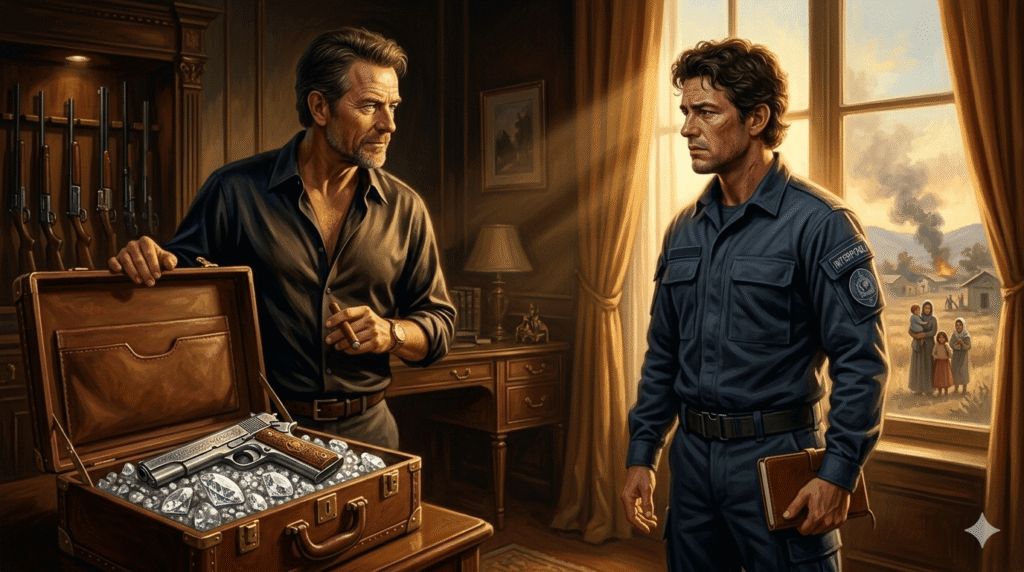
In California, twins William and Marcus were once inseparable, sharing even their passion for firearms. Their lives took a dark turn when a gun shop owner offered a secret deal: high-powered weapons in exchange for conflict diamonds from Africa.
The lure of wealth drew them into the gray shadows of arms trafficking. William handled the buying, while Marcus managed the international logistics. Within months, they lived in extreme luxury. However, a delivery trip to Africa changed Marcus forever. Witnessing the horrific impact of their cargo on innocent lives, he returned to California and told William, “This is blood money; we must stop.” William coldly dismissed him: “If we don’t do it, someone else will.”
This rift ended their brotherhood. Marcus left and joined an international task force, eventually using his insider knowledge to lead a raid—where he personally handcuffed his own brother. Behind bars, William roared, “Why? I’m your brother!” Marcus, with tears in his eyes, replied, “Because I love you, I had to choose what was right.” Even with the same genes, their choices defined who they ultimately became.
System Upgrade
Why do even twin brothers make such vastly different choices? Because each person’s Inner Map leads to a different destination. If your child tends to follow the crowd blindly, it means their Internal Navigation needs an upgrade. Research shows that children lacking Independent Value Judgment are significantly more likely to clash with parents due to peer pressure during adolescence. Conversely, children who learn to make Value Judgments early see these conflicts drop drastically.
👉 Subscribe now to unlock premium resources:
- Full Storyteller’s Script: A “ready-to-use” script for a bedtime story that children actually want to hear.
- Psychological Insights: A complete deep dive into mental maps, excuse rationalization, and how children can guard their bottom line.
- Parent-Child Dialogue Toolkit: Scripts to help children resist peer pressure and build independent judgment.
Unlock the full [MindFrame] package
Includes: full story script, psychological analysis, and parent–child guidance scripts. Unlock full contentSchalte das vollständige [MindFrame]-Paket frei
Dieser Beitrag enthält: vollständiges Drehbuch, tiefgehende psychologische Analyse und Eltern‑Kind‑Leitfäden. Vollständigen Inhalt freischaltenDébloquez le pack complet [MindFrame]
Cet article comprend : scénario complet, analyse psychologique approfondie et scripts de guidance parent‑enfant. Débloquer l’intégralité du contenuSblocca il pacchetto completo [MindFrame]
Questo articolo include: copione completo della storia, analisi psicologica approfondita e script di guida genitore‑figlio. Sblocca il contenuto completo[MindFrame] 完全アップグレードパッケージを解放
本文には、物語の完全な脚本、心理学的な深掘り解説、親子向けガイド用スクリプトが含まれています。 全文を解放するStoryteller’s Script
“Lean in a little closer, honey. Tonight, I’m going to tell you a story from California. It’s a heavy story, one that feels a bit like a movie, but it holds a truth we all need to understand.
In a sun-drenched house near the coast, there lived twin brothers: the older was William, and the younger was Marcus. Growing up, they were inseparable. They wore the same striped shirts, shared the same wooden blocks, and finished each other’s sentences. They were so close people said they had one soul between them. No one—not their parents, not their friends—could have imagined that years later, one of these brothers would be the one to put the handcuffs on the other.
Do you want to know how two people who start in the exact same place can end up worlds apart? It started with a hobby they both loved.
In California, if you follow the rules and pass all the tests, owning a firearm is legal. Both William and Marcus grew up fascinated by them. They spent their weekends at the firing range, their earmuffs tight against their heads, listening to the rhythmic pop-pop-pop of target practice. They were both experts, with steady hands and sharp eyes.
One afternoon, William received a call from a local gun shop owner. The man’s voice was low, filtered through a crackle of static. ‘William,’ he whispered, ‘I know you have some high-powered equipment in your collection. Are you looking to sell? I can offer you a price that will change your life.'”
“William was confused. ‘You’re a dealer,’ he said. ‘Why are you buying from a private collection?’
The man explained that he had ‘special clients’ who needed weapons immediately. They didn’t have cash, but they had something else: diamonds. Raw, glittering stones the size of ice cubes. These diamonds came from conflict zones in Africa—places where wars were raging and weapons were worth more than gold.
William told Marcus about the deal, and all they saw was a mountain of wealth. They stepped into the gray shadows of the arms trade. William became the buyer, sourcing the crates, while Marcus handled the logistics, ensuring the shipments reached the docks. Within months, their lives transformed. They traded their dusty sneakers for Italian leather shoes and moved into a mansion with a view of the ocean. They had everything they had ever dreamed of.
But then, Marcus had to go on a delivery trip himself.
He stood on a dusty plain, miles from home, and watched as the crates he had packed were pried open. He saw the weapons he had handled being turned on innocent people—on families and children whose terrified cries echoed in the heat. Marcus felt a sharp, sickening knot tie itself in his stomach. The diamonds in his pocket suddenly felt like jagged glass.
When he got back to California, he confronted William in their marble kitchen. ‘This has to stop,’ Marcus said, his voice trembling. ‘There is blood on this money, William. Those guns are destroying lives.’
William didn’t even look up from his bank statement. His face was like stone. ‘War is ugly, Marcus. That’s just the way the world works. If we don’t sell to them, someone else will. Don’t be naive.'”
“That argument broke the bond they had shared since the nursery. Marcus walked away. He didn’t just quit; he joined an international task force, using every secret he knew to track illegal shipments. Meanwhile, William sank deeper into the shadows, blinded by the glitter of the diamonds.
Not long after, Marcus stood in a dark warehouse, wearing a heavy tactical vest. He was the lead officer on the raid. When the lights went up, he found himself staring down the barrel of a familiar face. He was the one who clicked the handcuffs shut around his own brother’s wrists.
In the cold, quiet room of the detention center, William let out a jagged, desperate howl. ‘Why? How could you do this to me? I’m your twin! We’re the same!’
Marcus looked at him, his eyes swimming with tears, but his voice was steady. ‘I love you, William. But what you did destroyed families just like ours. I had to choose what was right.’
It’s a strange thing, sweetheart. Two brothers can grow up in the same house, eat the same meals, and look exactly alike in the mirror, yet see the world through completely different eyes. What feels like a ‘business deal’ to one person might be a tragedy to another.
We are all unique, and no two people ever see the world quite the same way. It’s the choices we make, not the faces we share, that tell the world who we really are.
(Gently hold your child’s hand or tuck the duvet in tight.)
The story is over for tonight. Close your eyes and feel how lucky we are to be here.
Goodnight, my love. Sleep tight.”
Psychological Insights
- Core Principle: No two people are exactly the same. This isn’t about personality; it’s about the “subjectivity of reality.” Even twins see the world through different lenses.
- Building the Personal Navigator Children follow the crowd because it feels safe. Guidance for Parents: Teach value prioritization. Ask: “If this gains you a toy but makes you lose sleep at night, which is heavier?” Help them build their own scale instead of using others’ eyes.
- Identifying the Rationalization Lie When people want to do something wrong, the brain invents excuses like “If I don’t do it, someone else will.” Guidance for Parents: Train logical decoupling. Tell them: “Other people’s mistakes can never be your excuse.”
- The Courage to Disagree Children fear losing relationships when they say “No.” Guidance for Parents: Model principles above relationships. Say: “I love you, but I don’t agree with what you did.” True love is pulling someone back when they’re on the wrong path.
MindFrame Scripts
Goal: Help children resist peer pressure and guard their inner bottom line.
- Expose the Excuse(scene: child says “everyone is doing it”) “You say everyone is doing it, but I think part of your heart feels uncomfortable. That’s your inner map speaking.”
- The Long-term Audit(scene: child tempted to follow peers) “If you throw away your principles just to please the group, will they respect you later? Is that a good deal?”
- Shift the Perspective(scene: child unsure how to act) “If you were a judge watching yourself right now, what advice would you give? How can you stay cool without following the crowd blindly?”
Growth Pulse
- [ ] Perspective Respect: Did I successfully identify the “Inner Map” behind my child’s behavior that is different from mine?
- [ ] Anchor Usage: Did I “cold-brake” my urge to force obedience and instead respect their cognitive uniqueness?
- [ ] Excuse Identification: Did I guide my child to dismantle a common “self-comforting excuse” in their daily life?
- [ ] Feynman Practice: Did I invite the child to retell the story to ensure the knowledge was successfully implanted?
Age & When to Use
- Recommended Age: 6–12 years old.
- Usage: Repeat 3–5 times for reinforcement.
- Best Scenarios:
- When a child faces peer pressure and is hesitant because “friends are doing it.”
- Building a correct view of money and responsibility (some benefits cannot be touched).
- Developing a “Leader Personality” where the child dares to voice a different opinion in a group.
© [ MindFrame ] All Rights Reserved. Patent-protected psychological scripts. Support original work; build a powerful operating system for child.