
A Note for Parents
Have you ever experienced such a moment? When your child faces a challenge, they slump their shoulders and say, “I can’t do it.” Or when you encourage them to try again, all you see is retreat and resignation.
That anxiety is natural. MindFrame invites you to shift your perspective: this might not be a lack of willpower, but rather a moment where their brain is trapped by a tiny “Mental Map.” They believe the two paths in front of them—”I can” or “I can’t”—are the entire world. This story doesn’t teach empty persistence; it leads children to observe a powerful truth: There are always more than two ways to solve a problem. Let’s accompany our children as they learn to find that “Third Way” when the road seems blocked.
What Child Will Learn?
This is more than just a story; it’s about installing three “Mental Tools” in your child’s mind:
- Identifying “Mental Dead Ends”: Understanding that when you feel helpless, it’s usually just your brain failing to pivot, not the end of the road.
- The Art of “Resource Assembly”: Realizing that big problems don’t require a single massive force; they can be solved by piecing together smaller channels (scholarships, grants, help).
- Building “Breakthrough Thinking”: Practicing how to stay calm after rejection and asking: “Besides the original plan, what other resources can I move?”
Story Summary
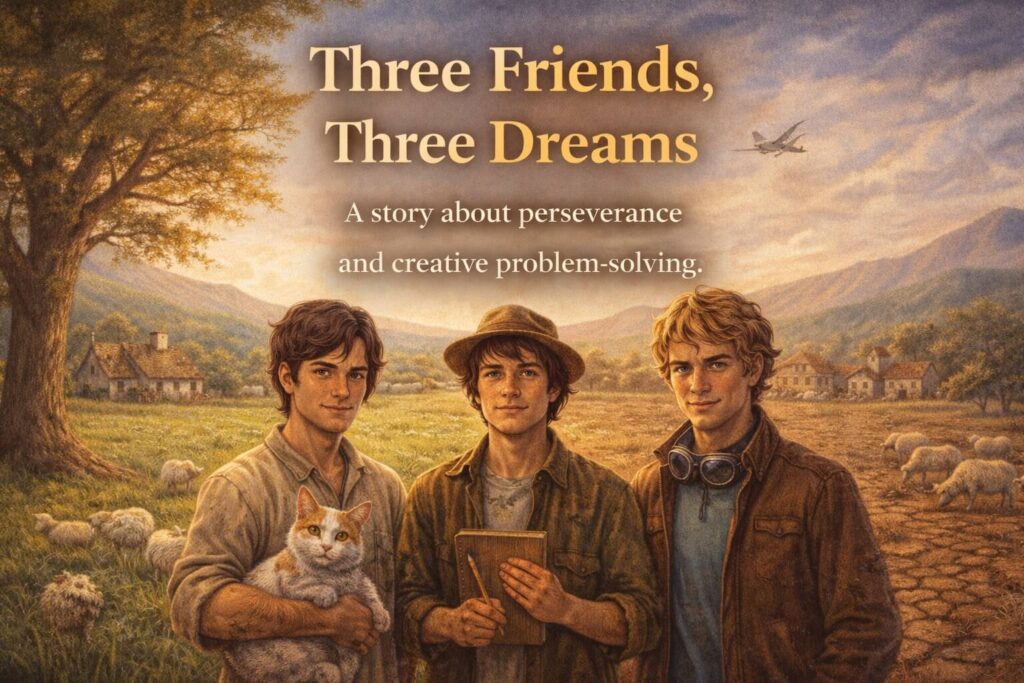
In the village of Willow Creek, friends Liam, Sophie, and William dreamed of becoming a vet, a writer, and a pilot. However, the wall of reality stood in their way: none of them could afford university.
To raise the money, William considered selling the family home but couldn’t bear to leave his family homeless; he gave up in despair. Sophie tried borrowing from relatives, but faced only cold rejections and closed doors; she hid her notebook away, heartbroken.
Only Liam refused to quit, fueled by a belief his father taught him: “There are always at least three ways to solve any problem.” He found the first way: a partial scholarship. He tried the second: a government grant. Even with a gap remaining, he stayed calm. He knocked on the door of the wealthy Mr. Sterling—his “Third Way.” He told the stranger: “I’ve tried two ways and raised most of it. If you help, I’ll be grateful; if you say no, I’ll find a fourth and fifth way until I succeed.” Impressed by this rare grit, Mr. Sterling invested in him. Liam proved that a dead end is just a test of flexibility.
System Upgrade
In a world of limited resources, will your child retreat or carve a new path?
Why did the other two youths give up after two tries? Their brains fell into the trap of binary opposition—it’s either this or nothing. But Liam understood: there is no such thing as “no way,” only “haven’t found the Third Way yet.” If your child habitually says “I can’t,” their Breakthrough Map needs an upgrade. Research shows children who learn to assemble different resources develop significantly higher resilience.
👉 Subscribe now to unlock premium resources:
- Full Storyteller’s Script: A “ready-to-use” script to tell a story your child will remember for a lifetime.
- Psychological Insights: A complete deep dive into how binary thinking weakens courage and how to build a high-resilience cognitive framework.
- Parent-Child Dialogue Toolkit: Scripts to instantly activate “Search Mode” when a child wants to give up.
Unlock the full [MindFrame] package
Includes: full story script, psychological analysis, and parent–child guidance scripts. Unlock full contentSchalte das vollständige [MindFrame]-Paket frei
Dieser Beitrag enthält: vollständiges Drehbuch, tiefgehende psychologische Analyse und Eltern‑Kind‑Leitfäden. Vollständigen Inhalt freischaltenDébloquez le pack complet [MindFrame]
Cet article comprend : scénario complet, analyse psychologique approfondie et scripts de guidance parent‑enfant. Débloquer l’intégralité du contenuSblocca il pacchetto completo [MindFrame]
Questo articolo include: copione completo della storia, analisi psicologica approfondita e script di guida genitore‑figlio. Sblocca il contenuto completo[MindFrame] 完全アップグレードパッケージを解放
本文には、物語の完全な脚本、心理学的な深掘り解説、親子向けガイド用スクリプトが含まれています。 全文を解放するAge & When to Use
- Recommended Age: 5–12 years old.
- Usage: Repeat 3–5 times for reinforcement.
- Best Scenarios:
- When a child hits a learning plateau (can’t solve a math problem or play a piano piece) and wants to quit.
- Resource conflicts (can’t afford a toy, no time for an activity)—training alternative thinking.
- Social setbacks—guiding the child to think of a “Third Interaction” besides fighting or ending the friendship.
© [ MindFrame ] All Rights Reserved. Patent-protected psychological scripts. Support original work; build a powerful operating system for child.